
A live craft workshop on how the different sounds and sonic textures in language affect the reader.
Summary
A lecture by Jonathan McClure
Overview and Goals — 0:00:01
Today’s topic is the use of sound—focused on poetry, though much of it applies to prose as well. In poetry, everything is so concentrated that it’s a bit easier to see these techniques in action.
The plan: start with an overview and some initial thoughts, then look at different flavors of using sound. First, internal rhyme, alliteration, and similar devices that enrich the texture of language. Then the rhythm of sentences. Then how sound and sentence rhythm create tone and a sense of who’s speaking. Then how lines, line breaks, sentences, and sounds all interact. And finally, some examples.
Robert Frost: The Ear as Writer — 0:00:45
Starting with a couple of quotes from Robert Frost. He’s always pretty spicy—very strong opinions, and he says them. (He famously said that writing free verse was like playing tennis without a net.)
The ear is the only true writer and the only true reader. I know people who read without hearing the sentence sounds, and they were the fastest readers. Eye readers, we call them. They get the meaning by glances, but they are bad readers because they miss the best part of what a good writer puts into his work.
The idea here is that the sense of sound is a key part of the writing process—and it often tells you things you may not consciously be aware of.
Frost also draws a distinction between what he calls “the sound of sense,” a term he keeps returning to. Separate from any semantic content, the sound of the words themselves conveys meaning. You can get that even without knowing what the words say—hence his metaphor of voices behind a door:
Now it is possible to have sense without the sound of sense, as in much prose that is supposed to pass muster but makes very dull reading, and the sound of sense without sense, as in Alice in Wonderland, which makes anything but dull reading. The best place to get the abstract sound of sense is from voices behind a door that cuts off the words.
He gives an example: “You mean to tell me you can’t read? I said no such thing. Well, read then. You’re not my teacher.” Take away the words, and you can still follow the gist of the argument.
A practical rule of thumb — 0:03:30
Read whatever you’re writing out loud to yourself. If a line or phrase sounds wrong, focus in on it—and think not just about why it sounds off, but about what it’s saying. In my experience, if something sounds wrong, that’s often a sign that something beyond just the sound is off too. Maybe you’re not saying quite what you mean to say, or the metaphor isn’t quite right. Usually I can tell something sounds wrong before I can figure out consciously why.
Catherine Pierce: “Anthropocene Pastoral” — 0:06:15
Here’s a poem I came across recently that does interesting things with sound. I’ll read it in full:
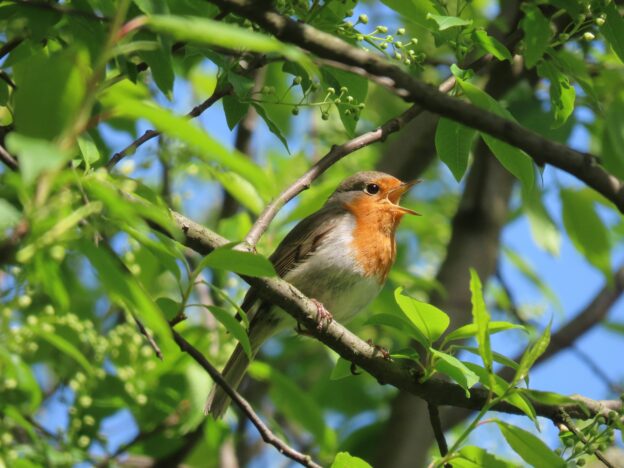
In the beginning, the ending was beautiful. Early spring everywhere, the trees furred pink and white, lawns the sharp green that meant new. The sky so blue it looked manufactured. Robins. We’d heard the cherry blossoms wouldn’t blossom this year, but what was one epic blooming when even the desert was an explosion of verbena? when bobcats slinked through primroses, when coyotes slept deep in orange poppies. One New Year’s Day, we woke to daffodils, wisteria, onion grass walking through the open windows. Near the end, we were eyelided, we were cottoned, we were sundressed and barefoot. At least it’s starting gentle, we said. An absurd comfort, we knew, a placebo. But we were built like that, built to say at least, built to reach for the heat of skin on skin, even when we were already hot, built to love the purpling desert in the twilight, built to marvel over the pink bursting dogwoods, to hold tight to every pleasure, even as we rocked together toward the graying, even as we held each other warmth to warm and said, sorry, I’m sorry, I’m so sorry, while petals sifted softly to the ground all around us.
Internal echo and sonic texture — 0:08:30
When I went through and tried to highlight every internal echo, alliteration, assonance, and so forth, I ran out of colors. And when I read it the first time it didn’t sound exaggeratedly rhymey—but there’s actually quite a lot of internal echo.
The lushness of all that layered sound mirrors the overabundance the poem is talking about: the unseasonable seasons of climate collapse, blossoms where there shouldn’t be. In this case there’s a direct echo between what the poem is saying informationally and how the sounds are being used.
You can look for this kind of thing in any poem. These sonic echoes within a line create a sense of richness, slow down the reading (when you have echoed sounds it slows your pace a bit), and elevate the language above normal speech—all at once.
Etymology and word sound — 0:15:45
Speaking broadly, Latinate terms tend to sound more clinical or academic—scientific—whereas their Germanic equivalents tend to sound more day-to-day, down-to-earth. Cemetery versus boneyard, for instance. Same idea, different feeling. When you use a word, you’re bringing its whole etymology and history along with it. Those feelings associated with it come along for the ride, even if not at a conscious level. (Worth noting: the terms I just used—”Latinate” and “Germanic”—are themselves Latinate and Germanic respectively. Didn’t even notice I was doing it.)
Sentence Rhythm and Variation — 0:17:30
Here’s the same poem with all informational content removed, keeping only the sentence structure—replaced with “word word word” placeholders, a new color for every sentence. The point is to show, purely through variation in sentence length and type, that something is happening structurally.
Variation is inherently interesting. It keeps things feeling fresh and avoids predictability. Compare: Here is a sentence. Here is another sentence. Here is another sentence. Pretty boring. As opposed to: Here’s a sentence and here’s another one. Yes, indeed. It’s another sentence. Another. Same idea, but varying the length and type keeps you on your toes.
Newer poets, especially those working in rhyme and meter for the first time, tend to have one thought per line—the next line resets as a new self-contained thought. You get the same length and type of sentence over and over, and it sounds repetitive. One quick fix: let the sentences and lines operate semi-independently. Wrap a sentence around multiple lines; have multiple sentences within a line. It immediately jazzes things up.
In “Anthropocene Pastoral,” Pierce favors extremely long wraparound sentences—fitting for a poem about overabundance—but she still punctuates with single words or shorter phrases. You can play with sentence length and type to reinforce meaning, while still mixing in variation.
Tone and the Character of the Speaker — 0:20:15
Three openings, very different speakers. As I read them, think about the sense of who’s speaking—and what it is about the language and the sentences themselves that makes you think that.
Keats, “London, 1802” — 0:20:30
Milton, thou shouldst be living at this hour, England hath need of thee. She is a fen of stagnant waters, altar, sword, and pen, fireside, the heroic wealth of Hall and Bower have forfeited their ancient English dower of inward happiness. We are selfish men. Oh, raise us up. Return to us again.
Very exclamatory, high-energy, almost frenetic—kids these days energy. Short, punchy phrases chopped into blocks of meaning: Milton, thou shouldst be living at this hour, colon. England hath need of thee, colon. She is a fen of stagnant waters, colon. The rhyming sounds in “fen of stagnant waters, altar, sword, and pen” reinforce the unpleasant feeling of the stagnation he’s describing.
One participant noted that diction is inseparable from sound here: swap Milton, thou shouldst be living at this hour for Milton, you really ought to be here and you get a totally different flavor.
T.S. Eliot, “The Love Song of J. Alfred Prufrock” — 0:25:45
Let us go then, you and I, when the evening is spread out against the sky, like a patient etherized upon a table. Let us go through certain half-deserted streets, the muttering retreats of restless nights in one-night cheap hotels and sawdust restaurants with oyster shells, streets that follow like a tedious argument of insidious intent to lead you to an overwhelming question. Oh, do not ask, what is it? Let us go and make our visit.
Much more meandering—long sentences spliced together with commas, varying line lengths, never quite knowing how long he’ll keep going. Dreamy, drifting, wandering. Paralyzingly self-conscious rather than bumbling, but with that hesitation, that indirectness.
The word etherized does a lot of work. It sounds different from everything around it—more elongated, a more prominent e sound. It’s also the only word here that marks a specific historical moment of medical technology. Everything else could be anywhere, any time: evening, sky, streets. But etherized anchors you to a particular moment and stands apart.
The final couplet—Oh, do not ask, what is it? / Let us go and make our visit.—is a turn. The rhyme feels like an ending; the rhythm snaps shorter, more dismissive. He’s imagining his interlocutor about to ask what he means, and preempting them: don’t ask, just come along. It yanks you down out of the dream.
Charles Simic, “Fork” — 0:33:30
This strange thing must have crept right out of hell. It resembles a bird’s foot worn around the cannibal’s neck.
A very different approach: strange, musing sentences presented in a direct way but saying odd things. He’s looking at a fork and finding it genuinely uncanny.
Line Breaks and Enjambment — 0:34:15
From Robert Pinsky’s The Sounds of Poetry (a very good craft book—highly recommended):
This resource, the angling of syntax into line and stanza at interesting tilts rather than in an end-stopped four-square manner, is supremely important. The variations of enjambment, the play between the symmetries of stop and return, the lines on one side and the twists of each sentence on the other, these are an important part of pleasure in poetry.
When you read a poem, you don’t stop fully at the end of every line—but your eye does scan back across the page, and those line breaks introduce small micropauses. The last word at the end of a line hangs in the air as your eye returns. That happens even more across stanza breaks. By letting something hang longer, that word gets a bit more emphasis. And that shift in timing adds information about pacing that you wouldn’t get in a block of prose.
The Pinsky line-break experiment — 0:35:45
Pinsky asks: which of these two arrangements is more useful?
Version A:
This is a schoolyard
crowded with children
of all ages
near a village
on a small stream
meandering by.
Version B:
This is a schoolyard
crowded with children of all
ages near a village on a small
stream meandering
by.
Pinsky comes down hard on the side of Version B, and I think I agree. Version A breaks only along the natural syntactical divisions—you could make it one block of prose and nothing would be lost. When a line does only that, it tends to start sounding repetitive in the same way that using the same sentence structure over and over can. Version B keeps you slightly unsettled: you never quite know where the sentence is going with each line break. Not suspense exactly, but a sense of interest—where is this going?
Williams, “The Red Wheelbarrow” — 0:38:30
The poem has never done that much for me personally—but what I find interesting about it is how it uses line breaks to create those little moments of suspense. So much depends / upon // a red wheel / barrow // glazed with rain / water // beside the white / chickens. Each break withholds then delivers: a red wheel—barrow, okay, now I have to revise the image; the white—chickens, the white what? He seems to be trying to create the experience of an image unfolding in steps rather than arriving whole.
The poem is also extremely ordered structurally: three syllables on the first line, two syllables on the second, through every stanza—extremely measured even as it seems chopped up and informal. An interesting contrast.
Sound as Mimesis: Three Examples — 0:44:00
Gerard Manley Hopkins, “The Windhover” — 0:44:15
I caught this morning morning’s minion, king- / dom of daylight’s dauphin, dapple-dawn-drawn Falcon, in his riding / Of the rolling level underneath him steady air, and striding / High there, how he rung upon the rein of a wimpling wing / In his ecstasy!…
Hopkins invented a metrical scheme called sprung rhythm—too in the weeds to go into here—but the sonic density of the poem is unmistakable. The alliteration, the internal echoes, the exact repetitions (morning morning’s)—it’s so lush and dense it’s actually hard to pronounce. It trips you up.
That density is trying to emulate the motion of the falcon skittering around—or more precisely, to mimic the ecstatic experience of watching the bird, rather than the bird’s flight itself. The poem feels like overwhelm, which is what watching something like that feels like.
He’s also well known for using language that can be difficult to parse semantically—but you get the emotional gist even before you can work out exactly what he’s saying. In Frost’s terms: the sound of sense comes before the sense itself.
William Carlos Williams, “The Dance” — 0:50:30
In Bruegel’s great picture, the Kermess, / the dancers go round, they go round and / around, the squeal and the blare and the / tweedle of bagpipes, a bugle and fiddles / tipping their bellies, round as the thick- / sided glasses whose wash they impound / their hips and their bellies off balance / to turn them. Kicking and rolling about / the Fair Grounds, swinging their butts, those / shanks must be sound to bear up under such / rollicking measures, prance as they dance / in Bruegel’s great picture, the Kermess.
An ekphrastic poem about a Bruegel painting, using sound to recreate the swirling motion of the dancers. A few things playing into it: heavy internal rhyme and repeating sounds; heavy enjambment across lines (it never stops at the end of a line, always circling back); images that don’t finish at the line break—you have to keep moving to get the full picture. And a very bouncy rhythm throughout.
This uses sound to mimic the thing being described in a more literal way than Hopkins, whereas Hopkins is mimicking the experience of watching more than the thing itself. But a similar underlying theory.
Tony Hoagland, “Reasons to Survive November” — 0:54:00
November like a train wreck, as if a locomotive / made of cold had hurtled out of Canada / and crashed into a million trees, flaming / the leaves, setting the woods on fire. / The sky is a thick, cold gauze. // But there’s a soup special at the Waffle House downtown, / and the Jack Parsons Show is up at the museum, / full of luminous red barns. Or maybe I’ll visit Donna, / the kickboxing queen from Santa Fe, / and roll around in her fold-out bed. // I know there are some people out there / who think I am supposed to end up / in a room by myself with a gun / and a bottle full of hate, a locked door / and my slack mouth open / like a disconnected phone. // But I hate those people back / from the core of my donkey soul / and the hatred makes me strong / and my survival is their failure / and my happiness would kill them, / and so I shove joy like a knife / into my own heart over and over / and I force myself toward pleasure. // And I love this November life / where I run like a train / deeper and deeper into the land of my enemies.
A more contemporary example—a very conversational voice still using sound to reinforce tone. The sounds are punchy, sharp, sometimes prickly in a way that mirrors the speaker. The orneriness comes through in the structure of the sentences: that driving relentlessness of run-on images.
The second stanza is notably different in cadence—calmer, more provisional. You can see him working: calming himself down, then working himself back up. There are good things in the world. But let me tell you about it.
The indented lines in the third and fourth stanzas—like a disconnected phone / in a room by myself—are interesting. One reading: the enjambment is being exaggerated; in both cases you’re left suspended on an open word, and the indentation amplifies the effect. Another reading: it’s highlighting disconnection visually, those lines alone in their own space. Probably both.
Closing Recommendations — 0:58:30
- Pinsky, The Sounds of Poetry — gets very deep into all of this, highly recommended
- T.S. Eliot, “Prufrock” — if you haven’t read the full poem, strongly recommended
- T.S. Eliot, “Preludes” — arguably his best poem, and criminally neglected
- Dr. Seuss set to rap — it’s illuminating in terms of sound and rhythm
About Instructor