

Allusions and Ekphrastic Writing
A lecture by Jonathan McClure
Overview — 0:00:23
The topic is putting your writing in conversation with other works—poems that respond to visual art (ekphrasis), allusions to other poems, stories, myths, films, or anything else. The session works through a sequence of examples, from Williams and Auden responding to Bruegel to Jonathan’s own poems from The Fire Lit and Nearing, to Hass and Atwood on the sirens and Homer—developing a set of guiding principles along the way and closing with a broader discussion about identity, the allusion spectrum, and how much a poem can demand of its reader.
Three Guiding Principles — 0:01:29
1. What does your piece do that the source work doesn’t already do? If you’re only describing what a painting looks like, why wouldn’t the reader just go look at the painting? The ekphrastic or allusive poem needs to offer something genuinely different—not better necessarily, just other. It needs to use a different medium, or a different angle, or a different set of concerns, to arrive somewhere the source work doesn’t.
2. The reference should be integral, not decorative. A poem stuffed with allusions as a display of erudition—look how many things I’ve read—is offputting, and it also just doesn’t do much. When allusion is working well, the poem couldn’t exist without it. The reference is structural, not ornamental.
3. How do you frame the reference? Different poets solve this differently. Robert Hass is a useful model: highly learned, often referring to works many readers haven’t encountered, but he does it in a conversational register—that scene in Virgil where—and provides just enough context that you can follow even without the background, while signaling where to go if you want more. This makes his allusions feel like an invitation rather than a gatekeeping test.
A fourth thing worth noting: the conversation should be genuinely two-way. An ekphrastic poem should ideally enrich how you see the painting, not just describe it—and seeing the painting should enrich how you read the poem.
Williams on Bruegel: The Kermess — 0:04:51
William Carlos Williams wrote a poem about Bruegel’s painting The Kermess—a street festival with a swirling circular dance, instruments, a general rollicking energy. The poem begins and ends with the same line (Bruegel’s great picture, The Kermess), forming a circle like the dance itself. Internally, the language does the same work: go round and around, the squeal and blare and tweedle of bagpipes, a bugle and fiddles, tipping their bellies, hips and bellies off balance—the words are jaunty, circular, spinning. Internal rhyme, sonic echo, rollicking rhythm. The poem translates the visual motion of the painting into the sonic and rhythmic motion of language.
This is a clear case of the poem doing something the painting can’t: not describing the dance but enacting it in a different medium. No ekphrasis is needed here—you could put the poem next to the painting and feel how they’re the same thing in different materials.
Williams and Auden on Bruegel’s Icarus — 0:15:25
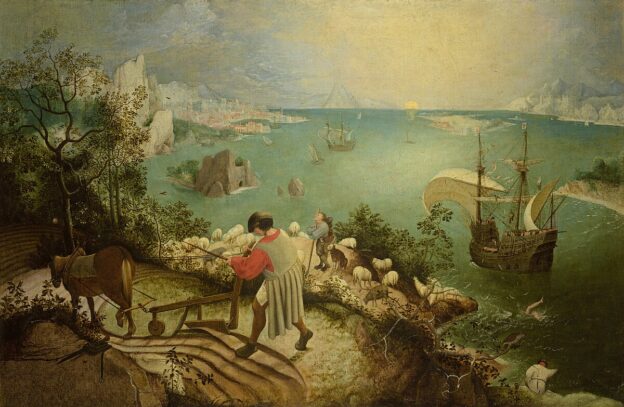
Two poems on the same painting: Bruegel’s Landscape with the Fall of Icarus, in which Icarus—just two white legs disappearing into the ocean in the bottom right corner—is entirely ignored by the plowing farmer, the ships at sea, the rest of the world going about its business.
Williams, “Landscape with the Fall of Icarus”: According to Brueghel / when Icarus fell / it was spring… there was a splash / quite unnoticed / this was / Icarus drowning. Jonathan’s honest assessment: it’s a famous poem, and the sound is pleasant, but it mostly says what the painting already says. Spring, the world awake and busy with itself, Icarus unnoticed in a corner. The poem doesn’t seem to go beyond its source.
Auden, “Musée des Beaux Arts”: Begins with a broader argument—About suffering they were never wrong, the old masters—and then zeroes in on the Icarus painting, with a digression through Bruegel’s Census of Bethlehem as well, where the birth of Christ is happening in a corner, barely noticed. In Brueghel’s Icarus, for instance: how everything turns away / quite leisurely from the disaster… the expensive delicate ship that must have seen / something amazing, a boy falling out of the sky, / had somewhere to get to and sailed calmly on.
The distinction Jonathan makes: the Auden may not add dramatically more than the painting in terms of content—but it adds a small and significant twist. In the painting, the world simply hasn’t noticed Icarus fall. In Auden’s reading, the plowman may have heard the splash; the ship must have seen something amazing. The world noticed, and went on anyway. That shift—from oblivious to indifferent—is something the painting itself leaves ambiguous, and Auden’s articulation of it is where the poem goes beyond the canvas.
A participant coined the phrase the banality of tragedy to describe the poem’s core observation—a gloss on Hannah Arendt’s banality of evil applied not to complicity but to the everyday world’s absorption in itself. The observation landed: both paintings, Auden points out, transpose ancient stories (Icarus, the Nativity) into Bruegel’s familiar Flemish landscape—Belgium, presumably, not Greece or Judea—and the effect is that even the most cosmic events are subject to the indifference of ordinary life.
Jonathan also noted the layering: we’re reading a 20th-century poem about a 16th-century painting about a Greek myth. Illusions within illusions.
Jonathan’s Own Work: The Fire Lit and Nearing — 0:26:00
Jonathan shared two poems from his own collection, explaining that he could speak to the intent in a way that’s impossible with other poets’ work. The collection’s overarching concern is a fraught relationship breaking down over time.
“Portrait of My Longings as a B-Movie Script” — Jonathan’s guilty fondness for terrible action movies (Kurt Russell’s Escape from New York specifically in mind) gave him a vehicle for writing about a failed relationship. The speaker imagines a life in which he has the right name (Dirk or Viper), rescues the president from a barracuda tank, his ex-wife Ellie (the nation’s top mathematician) watches him fight off spec-ops ninjas, and in the end, with the world saved and all losses avenged, he jet-packs into a mountainous sunrise leaving the president in awe / and Ellie wrapped in the long black fade / of her perfect regret.
The premise: whatever you’re living feels epic to you and absurd to everyone else. The relationship feels like a tragedy; from outside it’s not especially interesting, or is even kind of silly. The B-movie genre—with its single tear at the orchestral swell, its symbolic father-saving, its I guess I miscalculated you—enacts exactly that gap between the felt grandeur and the ridiculous reality.
Frederick’s reaction, shared during the session: one of the funniest poems he’d heard, and also genuinely emotionally affecting—funny and sweet and sad, generationally voiced (it feels like something a millennial specifically would write), and in his view, very, very good.
On attribution: a participant asked at what point an allusion requires acknowledgment. Jonathan’s rule of thumb is that if a poem is directly dependent on one specific work, credit it somehow—title, epigraph, or note. If it’s drawing on a broader field of tropes (B-movie conventions rather than one B-movie), you can usually omit it. He acknowledged the line is genuinely hard to draw: anything you write about is drawing on prior experience of the world, and in that sense everything is allusion.
“Odyssey 2” — The framing poem for the collection. In Homer’s Odyssey, after twenty years away—sacking Troy, then stranded at sea for mocking Poseidon—Odysseus returns home and unceremoniously kills the suitors who have been pursuing his wife. Homer presents this as triumphant. The poem imagines the sequel: the aftermath, the questions, the butchers and bakers going hungry since the island’s economy was based on the now-slaughtered suitors, the king striding the streets at night wailing Ithaca, Ithaca, waking the children and frightening the hounds. He thinks of old adventures and realizes he’d rather be back there. And what is Penelope beside the idea of Penelope / for whom he longs beside the sea—the final irony being that the thing he wanted, he has, and it can’t satisfy the wanting that sustained him.
The purpose in the collection: to set up the theme of what’s left when the heroism is stripped away, when the myth is punctured and what remains is a man who is lost even having returned. The gap between a person and the idea of that person—which runs through the whole book.
Two Siren Poems — 0:38:05
Another pair of riffs on the same source: the sirens from the Odyssey, who sing an irresistible song that lures sailors to their deaths. Odysseus has his crew stuff their ears with wax and ties himself to the mast to hear it without being able to throw himself overboard—becoming the only mortal to hear the song and survive.
Robert Hass, “Envy of Other People’s Poems” — In one version of the legend, the sirens couldn’t actually sing. It was only a sailor story. So Odysseus, lashed to the mast, was tormented by music he didn’t hear—only by sea wind, the offshore hunger of birds, the mute women gathering kelp for garden mulch, who see his awful longing and are changed forever on their rocky waste of island / by their imagination, his imagination / of the song they didn’t sing.
Jonathan’s reaction: I now envy this poem about envying other people’s poems. The cleverness is genuine—what if the entire myth is false, and Odysseus’s experience was the projection of his own imagination onto women gathering seaweed? But beyond the clever twist, the poem turns its attention to the sirens themselves, humanizing them: they’re just people going about their lives, changed forever by being seen as something they aren’t. And the title expands the poem’s implications beyond mythology—maybe we’re all imagining songs in one another’s work that aren’t there, and being changed by our imagination of them anyway.
A participant noted that both siren poems are fundamentally about poetry itself—and that in many languages, the word for poetry is the same as the word for song. Jonathan agreed the Hass is also an ars poetica, a poem about the nature of poetry and imagination.
Margaret Atwood, “Siren Song” — The poem is narrated by a siren who confides that the song is, in truth, a bore: This is the one song everyone / would like to learn: the song that is irresistible… Shall I tell you the secret? / and if I do, will you get me out of this bird suit? The siren doesn’t enjoy squatting on the island looking picturesque and mythical with these two feathery maniacs. The secret of the song: Help me. / Only you, only you can, you are unique / at last. And then: Alas / it is a boring song / but it works / every time.
The formal trick: the poem has been the song all along. The reader kept reading, was promised the secret, was told they were unique, leaned in—and fell for it. You were one more sailor. The siren’s weary acknowledgment that it’s a boring manipulation doesn’t make it less effective; neither does yours.
Robert Hass, “Heroic Simile” — 0:47:05
A final example, requiring several readings to fully appreciate. Hass’s title refers to the extended similes in Homer—he fell as Ajax fell, which then elaborates into a whole scene of woodcutters for ten lines before returning to the battle. This poem picks up the Homer reference (a swordsman falling in Kurosawa’s Seven Samurai falls as Ajax fell in Homer) and then literalizes the simile: we follow the woodsmen, the sawing, the quartering of timber, the uncle brought on the third day, the pine silt and spring mud—and Hass is increasingly obvious about the fact that he’s inventing this, improvising, forgetting to provide his woodsmen with a wagon, unsure at the end whether they’re Japanese or Mycenaean, the two source texts blurring.
The imagination has done something extraordinary and then revealed it can’t complete itself. The poem builds up this whole elaborated world from a single moment in a film, and then collapses it—not because the imagination fails, but because its limits become visible.
And then the final turn: A hero dying gives off stillness to the air. / A man and a woman walk home from the movies to the house / in the silence of separate fidelities. / There are limits to imagination.
That phrase—the silence of separate fidelities—is dense with what it doesn’t say. The couple is together and apart. The whole poem has been about the power of imagination to span worlds and centuries and media, and it closes on the one thing imagination can’t bridge: whatever is happening between two people walking home in silence.
A participant offered an interesting alternative reading: perhaps the man and woman aren’t the speaker and his partner but another couple the speaker is now imagining, still inside the habit of fantasy even after the film. Jonathan found this plausible. Either way, the poem is simultaneously a celebration of imagination and an elegy for its limits—which made it, as another participant noted, about both the power and the limits of imagining.
Closing Discussion: Identity and the Allusion — 0:55:45
Frederick offered a synthesizing observation on what made every poem in the session feel comfortable to read: none of the poets seemed shaken out of their own identity by the source work. You can fail in two directions when writing in relation to a great work—you can feel small by comparison and write defensively, or you can puff up and use the reference as a credential. What distinguished each of the poems shown was that the poet stayed fully in their own lived truth, and the source work enriched that truth rather than replacing it. The allusion was in service of something the writer genuinely had to say.
A related question came up: what about Eliot? His Tradition and the Individual Talent proposes that the poet’s job is to absorb the canon and recombine it with current reality—that the poet’s personality and lived experience are essentially irrelevant, that they’re a blender through which tradition and present moment are processed. Jonathan’s take: he finds that part of the argument unconvincing, though he does find Eliot’s observations about how new works retroactively change the meaning of old ones genuinely interesting. Eliot the theorist and Eliot the poet are both examples and counterexamples simultaneously—his Prufrock is deeply filtered through an idiosyncratic personality, even as the allusions multiply. He does it a lot; he’s famous for it; but the approach—of course don’t you speak ancient Greek?—is not one Jonathan would recommend.
The practical question this raises is: how much are you willing to require of your reader? There’s a spectrum from Eliot (you need everything) to someone who makes no references outside their own experience. Jonathan’s personal position is to give enough within the poem that a reader can follow even without the reference, while providing a thread to pull if they want more context. Where you land on that spectrum is a choice about audience—and there’s no objectively correct answer, only the implications of each position.
Recommended Reading — 0:54:11
Robert Hass, The Apple Trees at Olema: a selected poems drawing from his early work; the two poems discussed here appear in it. Highly recommended for anyone interested in how allusion can feel like conversation rather than performance.
Jonathan’s own collection: Jonathan McClure, The Fire Lit and Nearing (2018). The B-movie poem and the Odyssey poem appear in it, along with the rest of the sequence from which they’re drawn.
About Instructor


 +4
enrolled
+4
enrolled